Author
Shashi Shankar
Novellia
Date Published
June 3, 2026
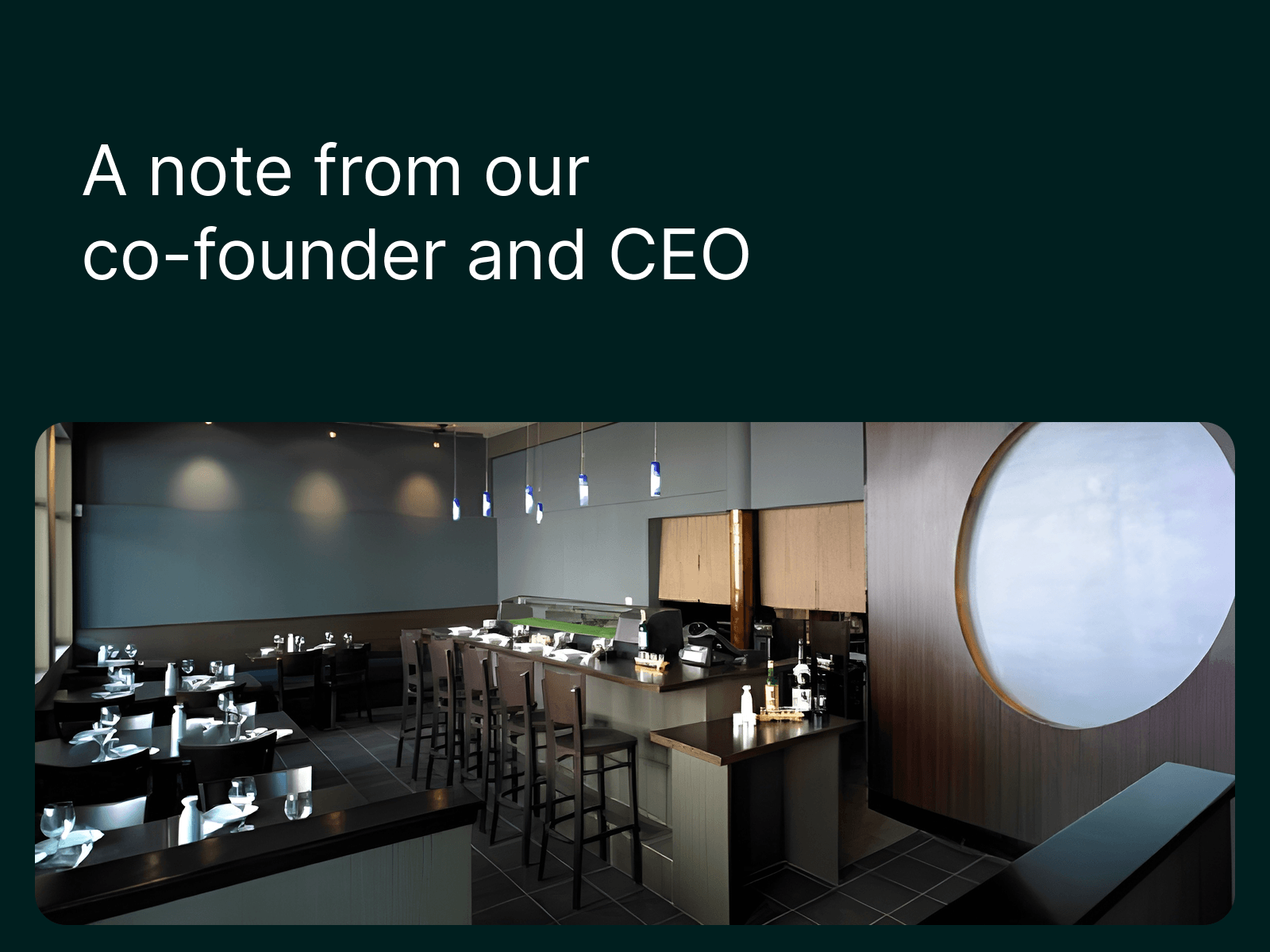
The sun was starting to melt into San Francisco's evening fog, its golden glow tucking into the thick blankets of clouds that poured into Hayes Valley - my hood - all the way from Twin Peaks and, beyond that, the Outer Sunset. I can't recall the exact time of year - it's hard to remember the changing of seasons in SF - but I remember it was a Thursday, and that it felt like autumn as I walked to Otoro Sushi.
The weather was my favorite type: cool, cozy, the kind that makes the city feel like it's been turned down a notch, quieter and softer and more honest. It felt like a perfect night.
But I was in the dumps.
I'd left my job recently to start Novellia. The moment I posted "building something new 😉" on LinkedIn, a flood of investors had messaged me. They said they wanted to meet. That I had an impressive background. That they had a “thesis” in this space and had been waiting for something new and innovative. They had a brand new, fresh, hungry fund. They’d invested in famous, legendary healthtechs, and were experts in the space. I remember sitting at my kitchen island, reading message after message, feeling something I can only describe as a sort of dangerous, delusional hope.
And while they were all kind enough to meet with me for 30 minutes, and were gracious and engaging and asked thoughtful and sharp questions, in the weeks since, not a single investor had emailed me back. I’d tried to follow up. I tried to create momentum in places where there wasn't any (we were pre-pre-seed, after all) and I packaged it up into hopeful little emails and sent them off into the void. Crickets.
And so, a friend had invited me to dinner that night at Otoro. She worked for one of the Valley's hottest startups, and she and the founders were grabbing sushi and I was welcome to join. What a much-needed learning opportunity, I thought. I'd sit next to The Successful Ones and absorb something essential just by being in the room. Maybe, and I really believed this at the time, they'd even want to invest. Strategic angels, as they say.
Halfway there, I grabbed my phone and refreshed my email.
Five unread messages. All from investors I'd met with. Finally writing back. Arriving at once, as if they'd coordinated. The stars were aligning. My heart kicked. I slowed down. I nearly walked into traffic on Octavia Street.
And then strange phrases I'd never heard before came at me one after another. Bow out. Concerned about defensibility. Insufficient TAM. Need more signal. Need to expand the product surface area. Chat post-traction. They sounded like a totally foreign language, each one feeling like a thousand little cuts to my ego. Every single investor was saying no. I stood there on the sidewalk reading them over and over again, and somewhere in the middle of the third or fourth re-read I noticed drops on my screen. It had started to rain. Almost gently, like the city was trying to wash the words off before I could finish reading them. I put my phone away and walked the rest of the way in silence.
I sat down at a long outdoor table at Otoro.
The first co-founder was there, the CTO. Young, clearly the technical one, unkempt hair, hoodie, the whole thing. He asked what I was building. I cleared my throat. Here it was, my big chance. I'd practiced this all afternoon. I got two sentences in before he stood up and high-fived someone who'd just walked in.
The CEO.
I remember being in total awe as I took him in. He was sharp yet easygoing, magnetic and confident. A total killer, I thought. No wonder this guy was becoming a legend. They fell into conversation. I didn’t care about finishing my pitch; here was my chance to be quiet, to observe, to learn how these guys thought.
The CEO had just come from Equinox, he said, where he'd had to practically hide in the locker room to avoid an investor who kept begging to invest in their company. They’d passed on this investor during their last fundraise and he had apparently never gotten over it. The CTO shook his head. The investor’s check size was the problem: the guy could only do $5M. Not worth their time. They laughed and poured themselves some sake.
I think my mouth was actually hanging open, in a mix of shock, confusion, and amazement. Was I really hearing this correctly? These guys were turning money down? And millions of dollars at that?
Here I was, unable to get anyone to take a second meeting with me, a phone full of rejections burning in my pocket, and there were founders out there turning down $5 million without a second thought.
I remember thinking. Wow. I really suck. I excused myself to the bathroom and locked the door. I was a loser. A joke. I’d left my dream job, something I’d worked so hard to achieve, something my parents were so proud of, to what? To become a complete failure? Someone who’s idea people didn’t even care to hear about at a dinner table? It wasn’t too late, I thought, to email my old boss and ask if I could come back. I’d only been gone a little while, and I’d left on good terms. I’d even take a pay cut. Just give me something real to hold onto. I remember how cold and refreshing the chipped porcelain felt on my forearms as I leaned over the sink and felt tears fall. My face was red hot, and I stood there for a while, hunched over, feeling extraordinarily sorry for myself.
Out of nowhere - and this is the God’s honest truth - I heard a voice. “Stand up”. And a million thoughts and images came colliding into me. I thought about my mom’s voice on the phone the day she told me my grandfather was gone. I thought about who I'd actually left my dream job for. People like my Tata. The patients living with cancer, the rarest diseases, the most complex conditions. The ones doing the most work at the moment they have the least capacity, whose stories sit broken and scattered across disconnected systems, who show up in almost no published research even though they need it most. They don’t have a bathroom to hide in where they can feel sorry for themselves and reach for an “I quit” button. I believed in something they deserved. And the version of me that believed it didn't get to stay in this bathroom. Not tonight.
I stood up. Splashed cold water on my face. Walked back out. Took a shot of sake (don’t tell my mom). Thanked my friend. And then walked home alone in the rain, sat down at my laptop, and got back to work.
That was close to three years ago.
I still think about that night every now and again. Not with sadness anymore, but more like the way you feel when you drive past a place where something important once happened to you. You slow down a little. You remember, and you appreciate something special and powerful about it.
Novellia has helped patients from nearly every corner of America - people living with cancer, rare diseases, conditions the healthcare system has never quite known how to look at squarely - unify tens of millions of medical records. We've given them something the system rarely hands over willingly: their own story, complete, in one place, finally legible. We've built technology that turns what our patients generously share with us into published research that moves medicine forward for the world’s leading life science companies. Our team has grown 10x. And in three years, we have never lost a single customer.
Today, I'm proud to announce Novellia's Series A. Everyone who has joined our mission, from employees to investors to customers to our incredible patient community, is bold enough to bet that the future of healthcare innovation runs through the patients who have always been the hardest to find and the most important to understand. The sickest. The most complex. The ones the system tends to look past. I've believed that since before we started Novellia, before we had a dollar of investment or revenue, before we had a single customer, before I had anything but a voice in a bathroom telling me to stand up.
Since that Thursday night at Otoro, we've raised nearly $30 million. But what I think about most isn't the dollars. It's the patients and the trust they’ve placed into an idea that I just simply couldn’t let go of.
There are so many more patients we haven't reached yet. People whose stories deserve to be found, heard, and made to count. They don't get to quit. We won't either.
Here’s to writing the next chapter.
LFG,
S
Let’s talk about how our patient authorized data can power your next milestone.